
Table of Contents
DC Fast Charger Maintenance in Hyderabad | 24/7 CPO Repair & AMC
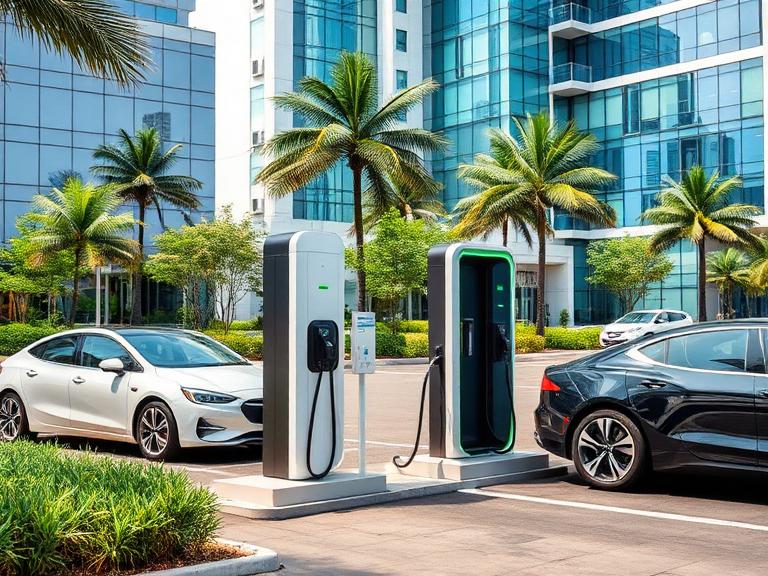
The rapid expansion of electric mobility across Greater Hyderabad—driven by commercial taxi fleets, public transit bus electrification (TGSRTC), corporate shuttles in HITEC City, and high-frequency intercity transit along the Outer Ring Road (ORR)—has created a dense network of Direct Current Fast Chargers (DCFC). Operating at power outputs ranging from 30kW up to 240kW+, these high-power charging cabinets are complex industrial energy conversion hubs.
When a commercial DC fast charger goes offline, the financial and operational fallout is immediate:
- Direct Revenue Loss: Uncaptured session fees and idle penalties during peak travel hours.
- Fleet Disruption: Stalled commercial delivery vans or corporate employee shuttles, leading to SLA breach penalties.
- Customer Churn: Frustrated drivers migrating permanently to competing CPO networks.
- Accelerated Hardware Asset Depreciation: Unaddressed minor thermal or electrical faults escalating into catastrophic component destruction.
Professional DC fast charger maintenance in hyderabad requires specialized high-voltage engineering expertise, deep familiarity with Central Electricity Authority (CEA) safety guidelines, advanced diagnostic tools, and dedicated field service protocols tailored to Telangana’s operating climate.
1. Technical Architecture & Primary Failure Modes of DC Fast Chargers
Unlike AC Level 2 wallboxes—which act as smart switches delivering AC current to the vehicle’s onboard converter—a DC Fast Charger houses high-power AC/DC rectifiers, forced liquid or air cooling systems, high-speed circuit protection, and complex digital communication hardware.
┌─────────────────────────────────────────────────────────────────────────────┐
│                INTERNAL DC FAST CHARGER HARDWARE TOPOLOGY                   │
├─────────────────────────────────────────────────────────────────────────────┤
│  3-Phase 415V AC Grid Supply (TGSPDCL Service Connection)                  │
│     │                                                                       │
│     v                                                                       │
│  Main AC Circuit Breaker (MCCB) + Class II Surge Protection Device (SPD)   │
│     │                                                                       │
│     v                                                                       │
│  Main AC Contactors & Phase Balance Monitoring Board                        │
│     │                                                                       │
│     v                                                                       │
│  Parallel AC/DC Rectifier Power Modules (e.g., 4 x 30kW = 120kW Total Bus)   │
│     │                                                                       │
│     v                                                                       │
│  High-Speed Semiconductor DC Fuses + Main DC Contactors                     │
│     │                                                                       │
│     v                                                                       │
│  SECC Controller (ISO 15118 / DIN 70121 Communication Protocol Engine)      │
│     │                                                                       │
│     v                                                                       │
│  CCS2 / CHAdeMO Dispensing Cables with Solenoid Locks & Temperature Sensors │
└─────────────────────────────────────────────────────────────────────────────┘
Primary Hardware Failure Modes in Greater Hyderabad
┌─────────────────────────────────────────────────────────────────────────────┐
│               PRIMARY DCFC HARDWARE FAILURE DIAGNOSTIC MATRIX               │
├─────────────────────────────────────────────────────────────────────────────┤
│  FAILURE 1: RECTIFIER POWER MODULE OVER-TEMPERATURE TRIP                    │
│  • Primary Cause: Clogged dust filters, failed 24V DC cooling fans, high    │
│    ambient summer heat (> 42°C).                                            │
│  • Maintenance Action: Clean intake mesh, swap DC fans, re-apply thermal paste.│
│                                                                             │
│  FAILURE 2: CCS2 GUN LATCH LOCK ACTUATOR MECHANISM FAILURE                  │
│  • Primary Cause: Mechanical latch wear, physical dropping, grit ingress.   │
│  • Maintenance Action: Replace 12V solenoid lock motor, calibrate alignment.│
│                                                                             │
│  FAILURE 3: HIGH GROUND RESISTANCE & EARTH LEAKAGE (> 5 OHMS)               │
│  • Primary Cause: Soil drying during summer, corroded chemical earth pits.  │
│  • Maintenance Action: Recondition chemical pit, re-torque copper bonds.    │
│                                                                             │
│  FAILURE 4: SECC / EVCC COMMUNICATION TIMEOUT (CP/PP SIGNAL LOSS)           │
│  • Primary Cause: Damaged control pilot wiring in cable, worn gun pins.     │
│  • Maintenance Action: Replace CCS2 cable harness, re-flash SECC firmware.  │
└─────────────────────────────────────────────────────────────────────────────┘
- Thermal Throttling and Power Module Failure: Hyderabad experiences prolonged summer temperatures exceeding 42°C. Forced air-cooled cabinets draw in dust and ambient heat. When intake filters clog, internal temperatures rise rapidly, forcing rectifiers into thermal derating (reducing output from 120kW to 30kW) or triggering total thermal shutdowns.
- Mechanical Damage to CCS2 Connectors and Cable Assemblies: High station turnover at commercial plazas in HITEC City and Gachibowli causes heavy physical wear. Dropping charging guns cracks connector shells, bends Control Pilot (CP) signal pins, and damages internal 12V solenoid locking actuators, preventing the charger from establishing a safe mechanical lock with the vehicle port.
- TGSPDCL Grid Voltage Sags and Transient Swells: Grid power fluctuations across industrial zones can cause contactor chatter, arc damage on main contactor points, degradation of metal oxide varistors (MOVs) inside surge arresters, and supply trips on sensitive digital control boards.
- Earth Pit Impedance Rise: CEA regulations dictate that ground loop resistance must remain strictly below 5.0 Ohms. During dry summer months, soil moisture around chemical earth pits evaporates, causing ground resistance to spike above safety thresholds and triggering automatic safety interlocks that block station operation.
2. Preventive Maintenance (PM) Protocols & CEA Safety Compliance
Preventive maintenance shifts operations from reactive firefighting to scheduled reliability management. Field service engineers execute structured maintenance routines aligned with Central Electricity Authority (CEA) guidelines.
┌─────────────────────────────────────────────────────────────────────────────┐
│                   PREVENTIVE MAINTENANCE SCHEDULE MATRIX                    │
├───────────────────────────┬───────────────────────────┬─────────────────────┤
│ Maintenance Scope         │ Inspection Frequency      │ Key Technical Task  │
├───────────────────────────┼───────────────────────────┼─────────────────────┤
│ Air Intake & Filters      │ Monthly / Bi-Monthly      │ Clean mesh, replace │
│                           │                           │ media, check CFM    │
├───────────────────────────┼───────────────────────────┼─────────────────────┤
│ Thermal Imaging & Torque  │ Quarterly (90 Days)       │ Infrared scan of    │
│ Inspections               │                           │ busbars, re-torque  │
├───────────────────────────┼───────────────────────────┼─────────────────────┤
│ CEA Earth Pit & RCD Audit │ Quarterly (90 Days)       │ Test ground < 5 Ω;  │
│                           │                           │ RCD trip < 30ms     │
├───────────────────────────┼───────────────────────────┼─────────────────────┤
│ Liquid Cooling Loop Flush │ Semi-Annual (180 Days)    │ Test fluid dielectric,│
│ (High-Power Dispenser)    │                           │ replace synthetic mix│
├───────────────────────────┼───────────────────────────┼─────────────────────┤
│ Insulation Megohmmeter    │ Annual (365 Days)         │ 1000V DC test       │
│ Testing                   │                           │ (Verify > 100 MΩ)   │
└───────────────────────────┴───────────────────────────┴─────────────────────┘
Statutory CEA Safety Audit Protocols
Under the Central Electricity Authority (Measures relating to Safety and Electric Supply) Regulations, public DC fast-charging stations must maintain verified safety documentation:
- Earth Pit Resistance Verification: Technicians measure ground impedance across primary equipment earth pits and neutral earth pits using 3-pole or 4-pole fall-of-potential earth testers. Resistance must be maintained strictly below 5.0 Ohms (and below 1.0 Ohm for multi-dispenser megawatt plazas).
- Residual Current Device (RCD/RCCB) Functional Test: Injecting calibrated 30mA DC fault currents to verify that Type B safety breakers trip and isolate the main supply within 30 milliseconds.
- Insulation Resistance (Megohmmeter) Scan: Applying a 1000V DC test voltage between positive/negative DC buses and frame ground. Insulation resistance must exceed 100 Megohms.
- Emergency Power Off (EPO) Functional Verification: Depressing the physical red EPO button on the cabinet exterior to confirm instant mechanical isolation of the incoming AC line contactor and internal DC bus contactors.
3. Step-by-Step Corrective Maintenance & Component Replacement
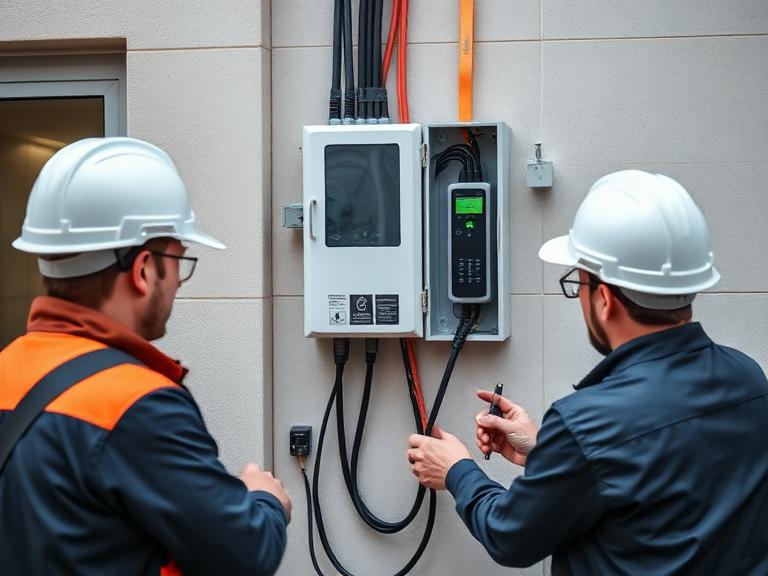
When a major component fails on a commercial DC fast charger, field service engineers execute strict high-voltage isolation protocols before carrying out repairs.
1.High-Voltage Isolation & LOTO Application:Step 1: Safety Perimeter Setup.
Isolate the upstream 415V 3-phase AC feeder at the main distribution sub-panel. Apply physical Lockout/Tagout (LOTO) padlocks and warning tags to the circuit breaker handle. Set up safety cones and high-voltage warning barriers around the charging station.
2.DC Bus Capacitor Discharge Verification:Step 2: Voltage Verification.
Open the cabinet door using insulated tools. Using a calibrated 1000V CAT IV digital multimeter, measure voltage across the positive and negative internal DC busbars to confirm that high-capacity smoothing capacitors have fully discharged to below 10 Volts DC before touching internal components.
3.Power Module / CCS2 Cable Disassembly:Step 3: Component Removal.
To replace a damaged CCS2 cable assembly: unbolt the copper output busbar terminations, unclip the Control Pilot (CP) and Proximity Pilot (PP) signal wiring harnesses, loosen the liquid-tight cable strain relief gland, and pull the damaged cable out of the cabinet housing.
4.OEM Component Installation & Busbar Torquing:Step 4: Precision Mounting.
Install the new OEM-certified CCS2 cable assembly or replacement 30kW AC/DC rectifier module. Clean all copper contact surfaces, apply conductive thermal paste to busbar joints, and torque high-tensile mounting bolts to exact manufacturer specifications using a calibrated torque wrench.
5.Insulation Resistance & Ground Continuity Audit:Step 5: Pre-Energization Testing.
Connect a 1000V DC megohmmeter between the DC output pins and the cabinet earth point, verifying insulation resistance exceeds 100 Megohms. Test continuity between the charging gun’s earth pin and the main earth pit, ensuring resistance remains below 0.1 Ohm.
6.Re-Energization & Operational Validation:Step 6: Live Testing & Go-Live.
Remove LOTO padlocks, close the upstream AC circuit breaker, and boot the system. Access the local SECC diagnostic terminal to verify CAN-bus module addressing, check temperature telemetry, perform a test session with an EV or test load, verify meter billing accuracy via OCPP, and clear the NOC fault ticket.
4. Software Diagnostics, OCPP Protocols, and NOC Operations
Modern DC fast chargers are intelligent edge devices. Effective maintenance combines physical field engineering with continuous cloud-based software management via a Network Operations Center (NOC).
┌─────────────────────────────────────────────────────────────────────────────┐
│                 NOC REMOTE DIAGNOSTIC & TELEMETRY ENGINE                    │
├─────────────────────────────────────────────────────────────────────────────┤
│  [ DC Fast Charger Cabinet ]                                                │
│         │                                                                   │
│         │ WebSocket Connection over 4G/5G / Industrial Ethernet             │
│         ▼                                                                   │
│  [ OCPP 1.6J / 2.0.1 / 2.1 Network Operations Center (NOC) Dashboard ]       │
│         │                                                                   │
│         ├── Real-time `StatusNotification` Processing (Fault Identification)│
│         ├── Remote `UnlockConnector` Execution (Emergency Release)          │
│         ├── Remote `Reset` Commands (Soft / Hard System Reboot)             │
│         └── Automated Field Engineer Dispatch Ticketing                     │
└─────────────────────────────────────────────────────────────────────────────┘
Key OCPP Messages in Maintenance Workflows
StatusNotification: Transmits real-time operational status and detailed error codes (HighTemperature,GroundFailure,OverCurrentFailure,ReaderFailure) from the charger to the NOC.UnlockConnector: Allows NOC operators to remotely override and release a stuck solenoid gun lock if a customer’s vehicle becomes locked to the cable port.Reset(Soft/Hard): Triggers a remote software reboot (Soft) or cuts internal auxiliary power supply relays (Hard) to clear transient software freezes without sending a technician on-site.GetDiagnostics/UpdateFirmware: Downloads internal diagnostic log files for root-cause analysis and flashes updated, tested firmware to resolve communication bugs.
5. Annual Maintenance Contract (AMC) Financial Models & Cost Structure
Charge Point Operators and commercial real estate directors in Greater Hyderabad can choose from structured AMC pricing models to maintain predictable operational budgets:
Comparative AMC Cost Matrix for DC Fast Chargers in Hyderabad
| Charger Power Rating & Hardware Configuration | Standard AMC (Quarterly PM + Labor Coverage) | Comprehensive AMC (PM + Labor + Full Spare Parts) | Emergency SLA Response Guarantee |
| 30 kW Single / Dual Gun DCFC | ₹28,000 – ₹42,000 / year | ₹55,000 – ₹85,000 / year | Within 4 Hours (Cyberabad Zone) |
| 60 kW Dual Gun CCS2 DCFC | ₹38,000 – ₹58,000 / year | ₹75,000 – ₹1,15,000 / year | Within 2 to 4 Hours (24/7) |
| 120 kW Dual Gun CCS2 Fast Charger | ₹58,000 – ₹85,000 / year | ₹1,20,000 – ₹1,75,000 / year | Within 2 Hours (Priority Dispatch) |
| 180 kW – 240 kW Ultra-Fast Charger | ₹85,000 – ₹1,25,000 / year | ₹1,80,000 – ₹2,60,000 / year | Within 2 Hours + On-Site Spare Module |
6. Frequently Asked Questions (15 Detailed FAQs)
1. What does comprehensive DC fast charger maintenance in Hyderabad entail?
Comprehensive DC fast charger maintenance includes 24/7 remote NOC monitoring via OCPP, preventive maintenance (air filter replacement, thermal imaging, liquid coolant flushing, torque checks), corrective hardware repairs (AC/DC rectifier power module replacement, CCS2 gun and cable repairs, contactor swaps, SECC board replacements), and mandatory Central Electricity Authority (CEA) safety compliance audits.
2. How often should commercial DC fast chargers undergo preventive maintenance in Hyderabad?
Due to Hyderabad’s summer temperatures exceeding 42°C, seasonal dust storms, and monsoon humidity, commercial DC fast chargers (60kW to 240kW) require scheduled preventive maintenance every 90 days (quarterly). High-utilization logistics hubs and e-bus depots require monthly air filter cleaning and thermal loop inspections.
3. What Service Level Agreements (SLAs) are typical for commercial CPOs in HITEC City and Gachibowli?
Tier-1 enterprise SLAs for commercial CPOs, fleet operators, and IT parks guarantee a 2-hour emergency field technician arrival time within Cyberabad, a 4-hour Mean Time to Repair (MTTR) for standard component failures, a 99.5% annual station uptime guarantee, and 24/7 automated NOC remote alert response.
4. What are the primary causes of DC fast charger failure in Greater Hyderabad?
The primary failure modes include: (1) Over-temperature shutdowns caused by dust-clogged air intake filters or failed cooling fans, (2) Mechanical damage to CCS2 charging gun pins and locking latch mechanisms, (3) AC/DC power conversion module failures due to TGSPDCL grid voltage spikes or thermal stress, (4) High ground resistance exceeding CEA limits (< 5 Ohms), and (5) Cellular 4G/5G modem disconnections.
5. How much does an Annual Maintenance Contract (AMC) cost for a DC fast charger in Hyderabad?
AMC costs depend on charger kilowatt output and SLA requirements. A standard 60kW dual-gun DC fast charger AMC ranges from ₹35,000 to ₹60,000 per year. High-capacity 120kW to 240kW units range from ₹65,000 to ₹1,40,000 annually for comprehensive coverage, which includes quarterly preventive checkups, 24/7 emergency field calls, labor, and spare parts replacement.
6. What electrical safety standards does the Central Electricity Authority (CEA) mandate for DC fast chargers in India?
CEA regulations mandate: (1) Double-earthing system with chemical pipe earth pits maintaining ground resistance strictly below 5.0 Ohms (below 1.0 Ohm for high-power multi-dispenser plazas), (2) Type B Residual Current Devices (RCCB/RCD) for DC leakage detection, (3) Class II Surge Protection Devices (SPD) on incoming AC lines, (4) Minimum 100MΩ insulation resistance between energized buses and frame earth, and (5) Emergency Power Off (EPO) isolation switches.
7. How do maintenance technicians repair a broken or damaged CCS2 charging gun cable assembly?
Technicians isolate the AC grid feeder using Lockout/Tagout (LOTO) protocols, discharge internal DC bus capacitors to below 10V, unbolt copper busbar terminations, disconnect Control Pilot (CP) and Proximity Pilot (PP) wiring harnesses, install an OEM-certified replacement cable assembly, torque all electrical joints to specification, perform a 1000V megohmmeter insulation test, and execute a live test charge.
8. What is the procedure for replacing a failed AC/DC power conversion module in a modular fast charger?
In modular DC fast chargers (e.g., 120kW powered by four 30kW modules), a failed module is identified via CSMS telemetry or local controller error codes. The technician isolates the unit, unscrews retaining brackets, slides out the hot-swappable module, verifies backplane busbar contacts, inserts a calibrated replacement module, configures module CAN-bus addressing, and verifies equal load sharing across active rectifiers.
9. How do maintenance teams handle liquid-cooled ultra-fast DC charging cables?
Maintenance for liquid-cooled cables involves testing glycol/synthetic coolant fluid levels, checking magnetic drive pumps for pressure loss, inspecting quick-disconnect fittings for micro-leaks, cleaning heat exchanger radiators, and flushing/replacing synthetic coolant according to manufacturer maintenance intervals.
10. Can multi-vendor maintenance providers service all DC fast charger brands operating in Telangana?
Yes. Certified multi-vendor maintenance providers service hardware from major OEMs including ABB, Siemens, Exicom, Servotech, Delta, Quench, Tritium, Schneider, and Mass-Tech. Technicians carry certified spare parts inventories for common sub-components such as contactors, SECC boards, display screens, and CCS2 guns.
11. How does TGSPDCL grid power quality impact DC fast charger lifespan, and how is it mitigated?
Voltage swells, sags, and harmonic distortion on distribution lines can cause AC contactor chatter, varistor degradation, and power module trips. Maintenance teams install motorized dynamic servo-voltage stabilizers, calibrate internal over-voltage/under-voltage trip windows, and fit Class II surge arresters to protect sensitive power electronics.
12. What remote diagnostic tools are used to prevent charger downtime before a failure occurs?
Operations teams monitor 24/7 Network Operations Center (NOC) dashboards integrated via OCPP 1.6J/2.0.1. By analyzing real-time data metrics—such as fan RPM, module temperatures, line voltage variations, and CP signal degradation—software algorithms flag early anomalies and trigger preventive maintenance dispatch before a complete breakdown occurs.
13. What happens when a charging cable solenoid lock fails and locks onto a customer’s EV port?
The NOC first issues a remote unlock override command over OCPP (UnlockConnector). If the internal 12V solenoid motor has failed mechanically, a field technician is dispatched with specialized release tools to manually release the mechanical locking pin from the vehicle port without causing damage.
14. How are fleet operators along the Outer Ring Road (ORR) supported during night charging shifts?
Fleet maintenance programs offer dedicated 24/7 shift coverage, maintaining on-site spare power modules, backup CCS2 cables, and standby technicians at high-volume logistics centers and bus depots to resolve charging disruptions immediately.
15. What documentation is provided after a DC fast charger safety and maintenance audit in Hyderabad?
Following a maintenance visit, CPOs receive a comprehensive Engineering Maintenance & Safety Audit Report. This includes earth pit resistance test logs, insulation test values, thermal imaging scans, module health scores, software/firmware revision numbers, and a CEA compliance certificate required for statutory regulatory audits.